
Blog
An Interactive Guide to 4 Fundamental Computer Vision Tasks Using Transformers
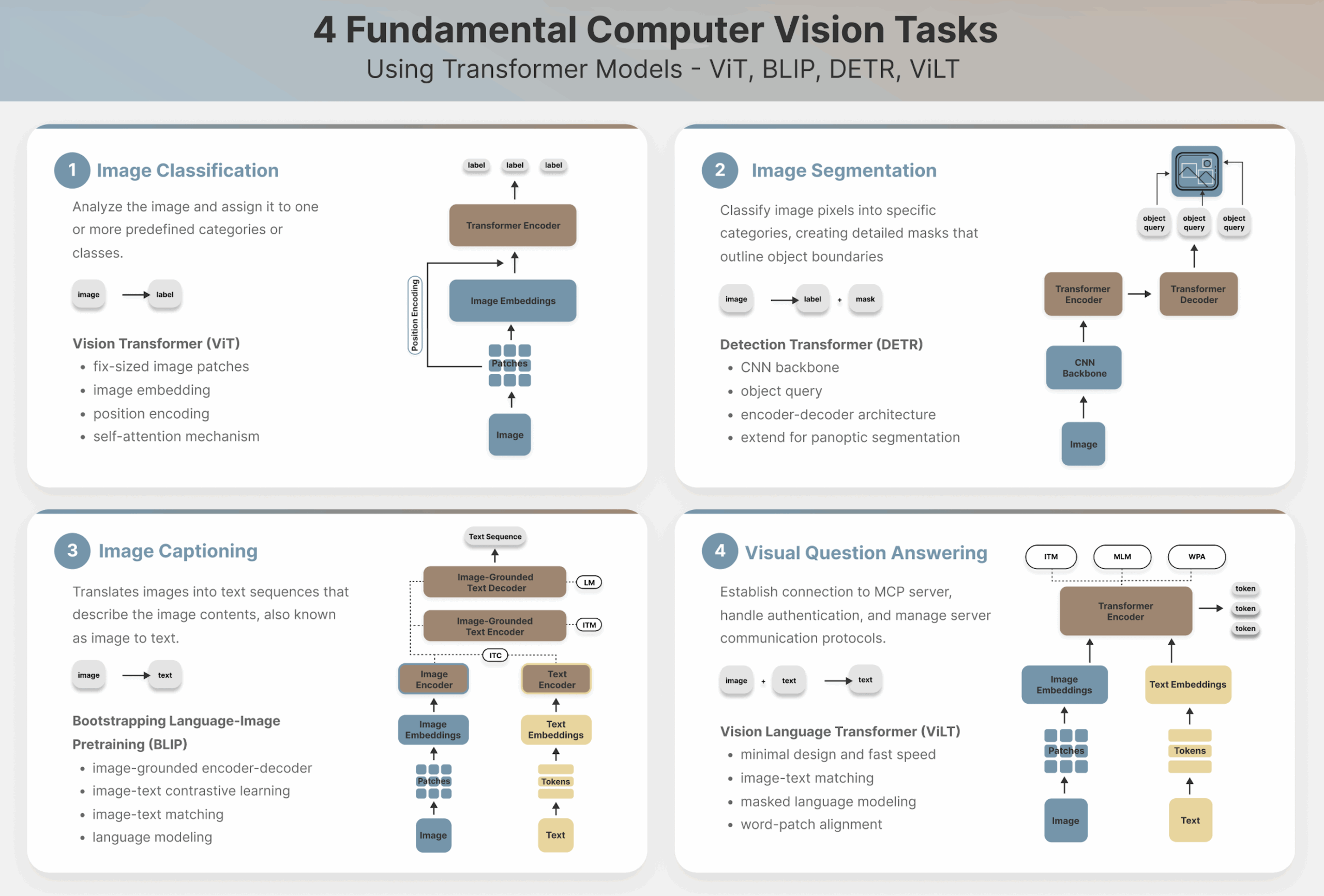
Understanding the Core Computer Vision Tasks with Transformers
Computer vision has gained significant momentum in recent years, thanks to the advent of deep learning and the integration of advanced models like transformers. These models have transformed how we perceive and process visual data, paving the way for innovations across various applications. In this blog post, we’ll delve into four fundamental computer vision tasks—object detection, image classification, semantic segmentation, and image generation—while exploring how transformers have redefined each area.
What are Transformers?
Before diving deep into specific tasks, it’s essential to grasp what transformers are. Originally introduced in the context of natural language processing (NLP), transformers are neural networks designed to handle sequential data. Their unique attention mechanism allows them to weigh the importance of different parts of the input when generating output, making them highly effective for a range of tasks, including those in the field of computer vision.
1. Image Classification: Identifying the Right Labels
Image classification is a foundational task in computer vision, where the goal is to assign a label to an input image based on its contents. Traditional methods relied heavily on convolutional neural networks (CNNs), but transformers have begun to outpace these models due to their ability to capture complex patterns in data.
How Transformers Enhance Image Classification
Transformers approach image classification differently by treating images as sequences of patches rather than pixels. This method enables them to leverage their attention mechanisms to focus on the most relevant parts of an image when determining its label. Recent implementations, like Vision Transformers (ViT), have demonstrated remarkable accuracy, even surpassing traditional CNN architectures in several benchmarks.
2. Object Detection: Locating and Identifying Objects
Object detection goes beyond simple classification by identifying and localizing multiple objects within an image. This task involves determining not just what objects are present, but also where they are located.
Leveraging Transformers for Object Detection
Transformers have recently been adapted for object detection through models such as DETR (DEtection TRansformer). Unlike conventional methods that require anchor boxes and post-processing steps, DETR directly predicts bounding boxes and classes using a transformer decoder. This streamlines the object detection pipeline, simplifying training and achieving impressive results on standard datasets.
3. Semantic Segmentation: Understanding Pixels
Semantic segmentation involves classifying each pixel in an image into predefined categories, allowing for a more granular understanding of scene elements. This task is crucial for applications like autonomous driving, where accurate scene understanding is vital.
Transformers in Semantic Segmentation
Transformers have been successfully employed in semantic segmentation by providing a more holistic view of the image. Architectures like Swin Transformer break down images into patches while retaining rich contextual information. This approach improves the model’s ability to distinguish between objects in cluttered scenes, offering better segmentation performance than traditional methods.
4. Image Generation: Creating New Content
Image generation is one of the most fascinating areas of computer vision, where the goal is to create new images, often conditioned on certain inputs. This task has applications in content creation, style transfer, and even medical imaging.
The Role of Transformers in Image Generation
Transformers have revolutionized image generation through generative models such as DALL-E and GANs (Generative Adversarial Networks) augmented with transformer architectures. These models can generate highly realistic images based on textual descriptions or existing images, showcasing the power of transformers in grasping and recreating complex visual concepts.
The Benefits of Using Transformers in Computer Vision
The adoption of transformers in computer vision offers a plethora of benefits. Here are some key advantages:
-
Scalability: Transformers can efficiently handle large datasets, which is crucial for training complex models on diverse image collections.
-
Flexibility: Unlike traditional models that require task-specific adjustments, transformers can be fine-tuned for various computer vision tasks without extensive re-engineering.
- Improved Performance: Experiments show that models based on transformers often achieve higher accuracy and better generalization compared to their CNN counterparts, reflecting their stronger ability to learn contextual relationships.
Challenges and Future Directions
Despite their successes, the application of transformers in computer vision is not without challenges. One major issue is the high computational cost, which can limit their practical applications. Additionally, large-sized transformer models require extensive amounts of labeled data to perform optimally, posing a barrier in situations where data is scarce.
As the field continues to evolve, researchers are actively working on addressing these challenges. Innovations such as model distillation and hybrid architectures that combine CNNs and transformers are emerging as potential solutions. Future research aims to optimize performance while reducing the resource requirements, making transformer-based models accessible for a wider range of applications.
Conclusion
Transformers have ushered in a new era for computer vision tasks, significantly enhancing image classification, object detection, semantic segmentation, and image generation. Their unique capabilities enable models to learn richer representations of visual data, leading to improvements in accuracy and efficiency. As research continues to advance, we can expect transformers to play an increasingly vital role in shaping the future of computer vision, unlocking new possibilities and applications.
By embracing the strengths of transformer architectures and addressing their challenges, we are setting the stage for innovative solutions that can transform how we interact with visual data. The potential is vast, and the future of computer vision is bright, fueled by the power of transformers.
