
Blog
Google DeepMind Finds a Fundamental Bug in RAG: Embedding Limits Break Retrieval at Scale
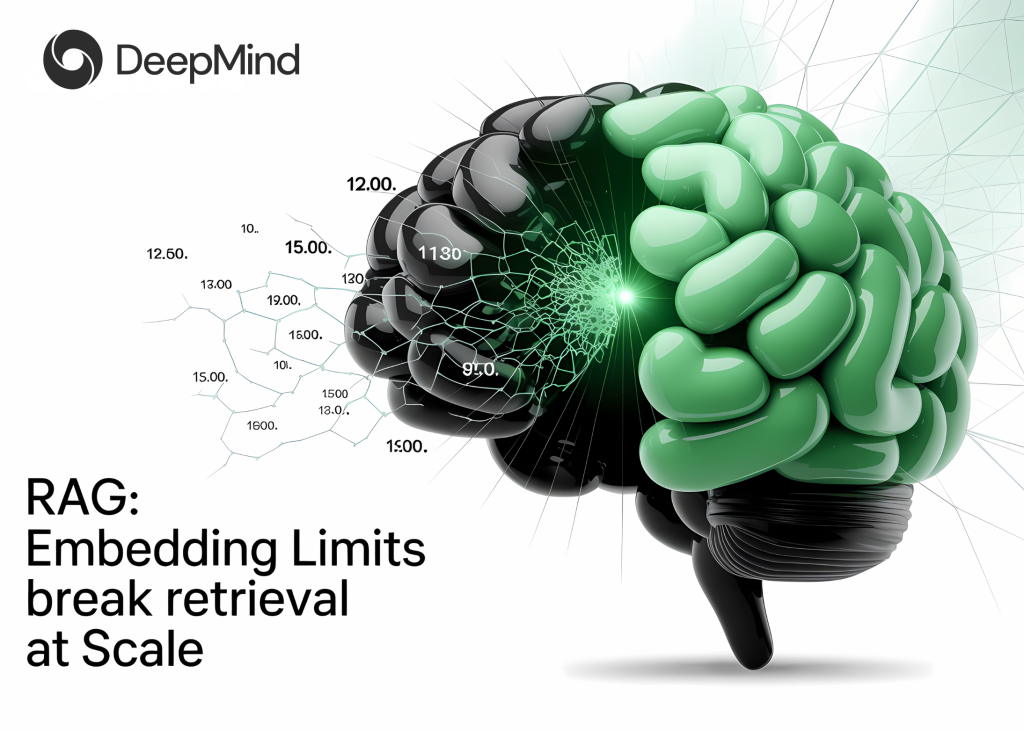
Understanding the Limitations of RAG
In the ever-evolving landscape of artificial intelligence, the integration of retrieval-augmented generation (RAG) models has marked a significant advancement in how machines access and utilize information. However, recent findings from Google DeepMind have shed light on a fundamental issue that could hinder the scalability of these models. This post will explore the implications of this discovery and how it shapes the future of AI retrieval systems.
What is RAG?
Retrieval-augmented generation, or RAG, merges two pivotal technologies: retrieval systems and generative models. The retrieval component identifies relevant information from vast databases, while the generative aspect composes coherent and contextually appropriate responses. This synergy enhances the machine’s ability to generate accurate and informed answers based on real-time data retrieval, providing users with enriched content.
The Recent Findings by Google DeepMind
Google DeepMind recently identified a significant limitation within RAG systems: embedding limits. These embeddings, which serve as the mathematical representation of data points, play a critical role in how well a model retrieves information. When the volume of data surpasses predefined embedding limits, RAG models face challenges in fetching and utilizing information effectively. This limitation can significantly affect the efficiency and accuracy of the models, especially when deployed at scale.
The Challenge of Embedding Limits
What Are Embeddings?
Before delving deeper into the implications of embedding limits, it’s essential to understand what embeddings are. In machine learning, embeddings are dense vector representations of data that capture essential relationships and characteristics in lower-dimensional space. They enable the model to understand and process complex data more efficiently.
Why Limitations Matter
As RAG models attempt to process an ever-increasing amount of information, the restrictions imposed by embeddings can lead to a decline in performance. When the limits are reached, the model may struggle to prioritize pertinent information, leading to slower response times and decreased accuracy in the generated content. This can pose challenges for applications that rely on real-time data, such as customer support systems, content generation, and search engines.
Implications for AI Development
Decreased Efficiency
One of the most pressing concerns related to embedding limits is decreased efficiency. As models reach their capacity, they might waste computational resources on irrelevant data rather than focusing on the most pertinent information. The result is a slower and less effective system, which could detract from user experience and satisfaction.
Strain on Resources
The limitations of RAG systems can also place a strain on computing resources. Companies relying on these models must either invest in more powerful infrastructure or adjust their methods to function within the constraints of existing embeddings. This dilemma can escalate operational costs, making it challenging for businesses to maintain an efficient workflow.
Impact on Real-Time Applications
Real-time applications heavily depend on the swift retrieval of accurate information. As embedding limits hinder performance, the integrity of these applications may be compromised. For example, in areas such as virtual assistants, chatbots, and automated customer service, users expect prompt and precise responses. If the backend model struggles due to embedding constraints, the overall effectiveness of such applications ultimately suffers.
Strategies to Address Embedding Limits
Despite the challenges posed by embedding limits, there are several strategies developers and researchers can consider to mitigate these issues.
Optimizing Embedding Techniques
To enhance the capabilities of RAG models, refining embedding techniques is paramount. By exploring various dimensionality reduction methods and representation strategies, developers can create more efficient embeddings that better capture essential information without exceeding limits.
Implementing Layered Systems
Another potential solution is to create layered retrieval systems. Instead of relying solely on a single RAG model, developers can build systems that use multiple models operating at different layers. This approach could help distribute data across models, enabling simultaneous retrieval from multiple sources and improving overall performance.
Exploring Hybrid Models
Researching hybrid models that combine traditional search methodologies with newer generative approaches may offer alternative solutions. By fusing these techniques, developers can leverage the strengths of both while circumventing the limitations imposed by embeddings.
The Future of RAG and AI Retrieval
Continuous Research and Adaptation
As AI technology advances, ongoing research is essential to address the inherent limitations of RAG and embedding systems. By continuously exploring new methods, algorithms, and techniques, the AI community can foster the development of more robust and efficient models.
Embracing a Holistic Approach
Addressing the challenges of embedding limits requires a holistic approach that encompasses not only technological adaptations but also an understanding of user needs and applications. By collaborating closely with various stakeholders, from researchers to end-users, developers can create solutions that enhance the overall effectiveness of AI retrieval systems.
Looking Toward Scalability
Ultimately, the ability of RAG models to scale effectively relies on overcoming the challenges posed by embedding limits. By developing innovative strategies and approaches, the AI community can create systems that not only meet current demands but are also capable of adapting to future challenges.
Conclusion
The recent findings from Google DeepMind highlight a critical limitation in retrieval-augmented generation systems, shedding light on the complex interplay between data retrieval and generation. Understanding embedding limits is key to making meaningful advancements in AI technologies. While challenges exist, ongoing research and innovative solutions will pave the way for more efficient and effective AI retrieval systems. By embracing collaboration and holistic thinking, the AI community can work together to create models that meet the evolving demands of the digital landscape.
