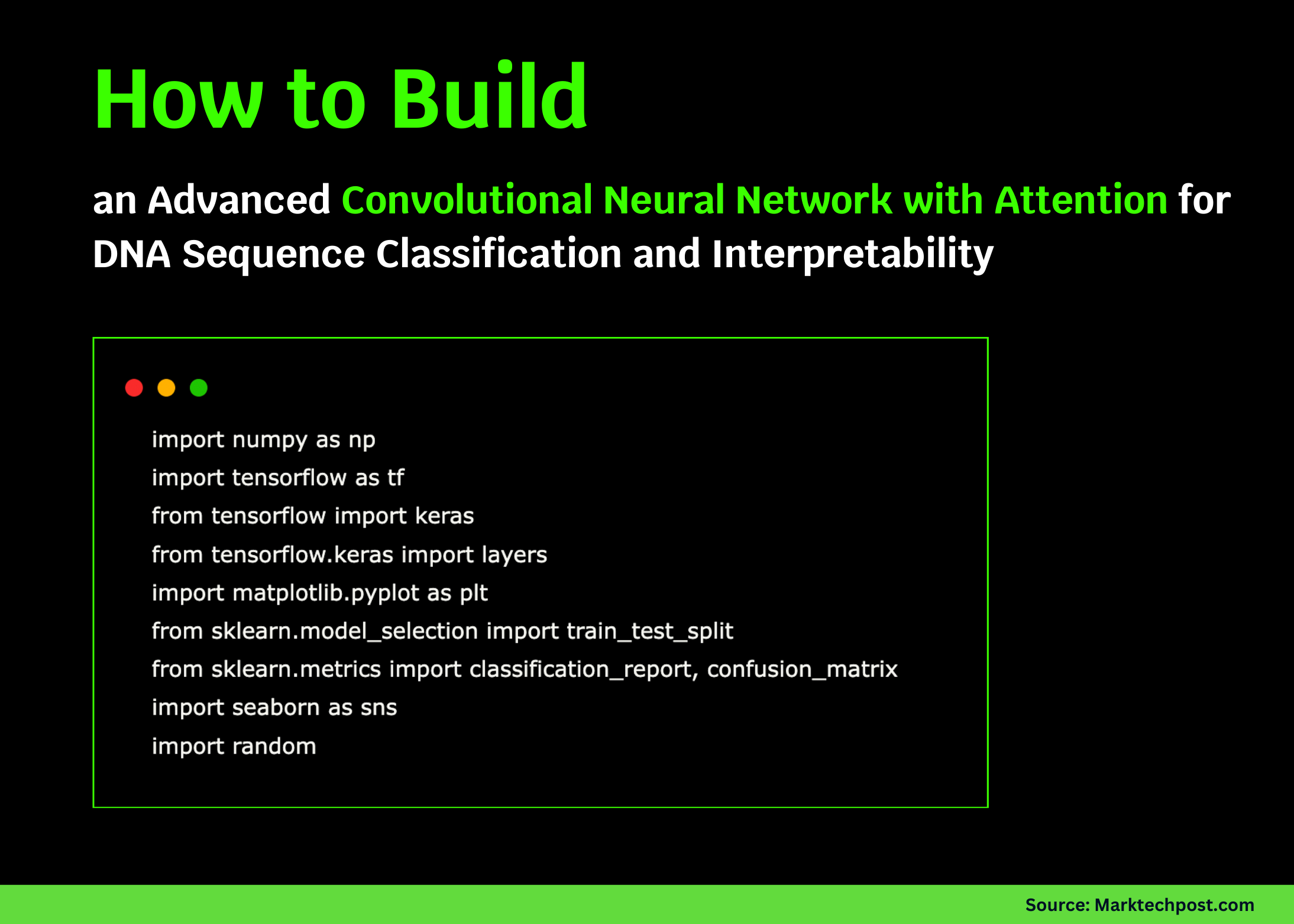
Introduction to Convolutional Neural Networks for DNA Sequence Classification
In the realm of bioinformatics, the classification of DNA sequences using machine learning has gained significant importance. Convolutional Neural Networks (CNNs) have emerged as a powerful tool for analyzing biological data due to their proficiency in recognizing patterns. This blog post explores the construction of an advanced CNN model integrated with attention mechanisms specifically designed for DNA sequence classification, while also highlighting the model’s interpretability.
Understanding DNA Sequences
DNA sequences are composed of nucleotides, which are represented by the letters A, T, C, and G. Each of these letters corresponds to a specific genetic code. Classifying these sequences enables researchers to identify functions, predict structures, and understand biological processes. However, the complexity of DNA data necessitates sophisticated analytical techniques, as traditional algorithms often fall short in capturing intricate patterns.
What Are Convolutional Neural Networks?
Convolutional Neural Networks are a class of deep learning models primarily used for image processing but have recently been adapted for various sequential data applications, including DNA sequence classification. CNNs utilize convolutional layers to automatically extract features from the input data, making them ideal for tasks where spatial hierarchies are crucial.
Key Components of CNNs
- Convolutional Layers: These layers apply convolution operations to extract features from the input data.
- Activation functions: Commonly, ReLU (Rectified Linear Unit) is employed to introduce non-linearity into the model.
- Pooling Layers: Used to reduce the dimensionality of the feature maps, allowing the model to focus on the most critical aspects of the data.
- Fully Connected Layers: At the end of the network, these layers are responsible for making predictions based on the features extracted from the previous layers.
The Role of Attention Mechanisms
While CNNs are powerful, they can have limitations in recognizing long-range dependencies within sequences. This is where attention mechanisms come into play. Attention allows the model to focus on specific segments of the input data that are more relevant to a particular classification task.
Advantages of Attention in DNA Classification
- Enhanced Interpretability: By highlighting the regions of the input data that contributed significantly to the model’s decision, researchers can better understand the behaviors encoded in DNA sequences.
- Improved Performance: Attention mechanisms can lead to better classification accuracy by allowing the model to concentrate on the most informative portions of the data.
- Dynamic Focus: Unlike traditional feature extraction, attention mechanisms provide a dynamic method for determining which parts of the sequence are most relevant during inference.
Building an Advanced CNN with Attention Mechanisms
Creating a CNN with attention for DNA sequence classification involves several essential stages. Below, we outline the step-by-step process.
Data Preparation
- Data Collection: Start by gathering a comprehensive dataset of DNA sequences, ensuring diversity in the samples to improve model generalization.
- Data Encoding: Convert nucleotide sequences into numerical formats suitable for input into the CNN. Techniques like one-hot encoding or K-mer encoding are commonly employed.
- Data Splitting: Divide your dataset into training, validation, and testing sets. This helps in assessing the model’s performance and avoids overfitting.
Model Architecture
- Input Layer: This layer receives the encoded DNA sequences.
- Convolutional Layers: Stack several convolutional layers to extract features. Experiment with different kernel sizes to identify the most effective architectural design.
- Pooling Layers: Integrate pooling layers to down-sample the feature maps. This can be achieved through max-pooling or average pooling.
- Attention Layer: Introduce the attention mechanism after the convolutional layers. This layer calculates the importance scores for each part of the sequence, allowing the model to focus on the most relevant sections.
- Fully Connected Layers: Connect to one or more fully connected layers that lead to the output layer. The output layer represents the classification results, typically employing a softmax activation for multi-class problems.
Training the Model
- Loss Function: Choose an appropriate loss function, such as categorical cross-entropy for multi-class classification tasks.
- Optimizer: Utilize optimizers like Adam or SGD (Stochastic Gradient Descent) to minimize the loss function during training.
- Hyperparameter Tuning: Adjust hyperparameters including batch size, learning rate, and the number of epochs to optimize the model’s performance.
Evaluating the Model
After training the model, evaluate its performance using the validation and test datasets. Key metrics include accuracy, precision, recall, and F1-score. These metrics provide a comprehensive understanding of how well the model performs in classifying DNA sequences.
Ensuring Interpretability
The interpretability of machine learning models, especially in fields like bioinformatics, is of utmost importance. Model interpretability allows researchers to trust the decisions made by the model and justify them in a biological context.
Visualization Techniques
- Attention Weight Visualization: Plotting attention weights can shed light on which parts of the DNA sequence were most influential in the classification decision.
- Activation Maps: Visualizing feature maps from different layers can also reveal how the model is learning to represent the data.
- Decision Trees: Incorporating simpler models, like decision trees, can help in understanding complex model predictions by providing clearer insights into how features interact.
Conclusion
Building an advanced Convolutional Neural Network with attention mechanisms for DNA sequence classification is both a challenging and rewarding endeavor. Through thoughtful model design, careful data preparation, and a focus on interpretability, researchers can harness the power of deep learning to gain insights into genetic data. As the field of bioinformatics continues to evolve, the integration of advanced methods like CNNs and attention will pave the way for groundbreaking discoveries in genetics and molecular biology. By bridging the gap between computational techniques and biological understanding, we can unlock the vast potential hidden within DNA sequences.