Understanding GPU-Optimized Software Frameworks for AI
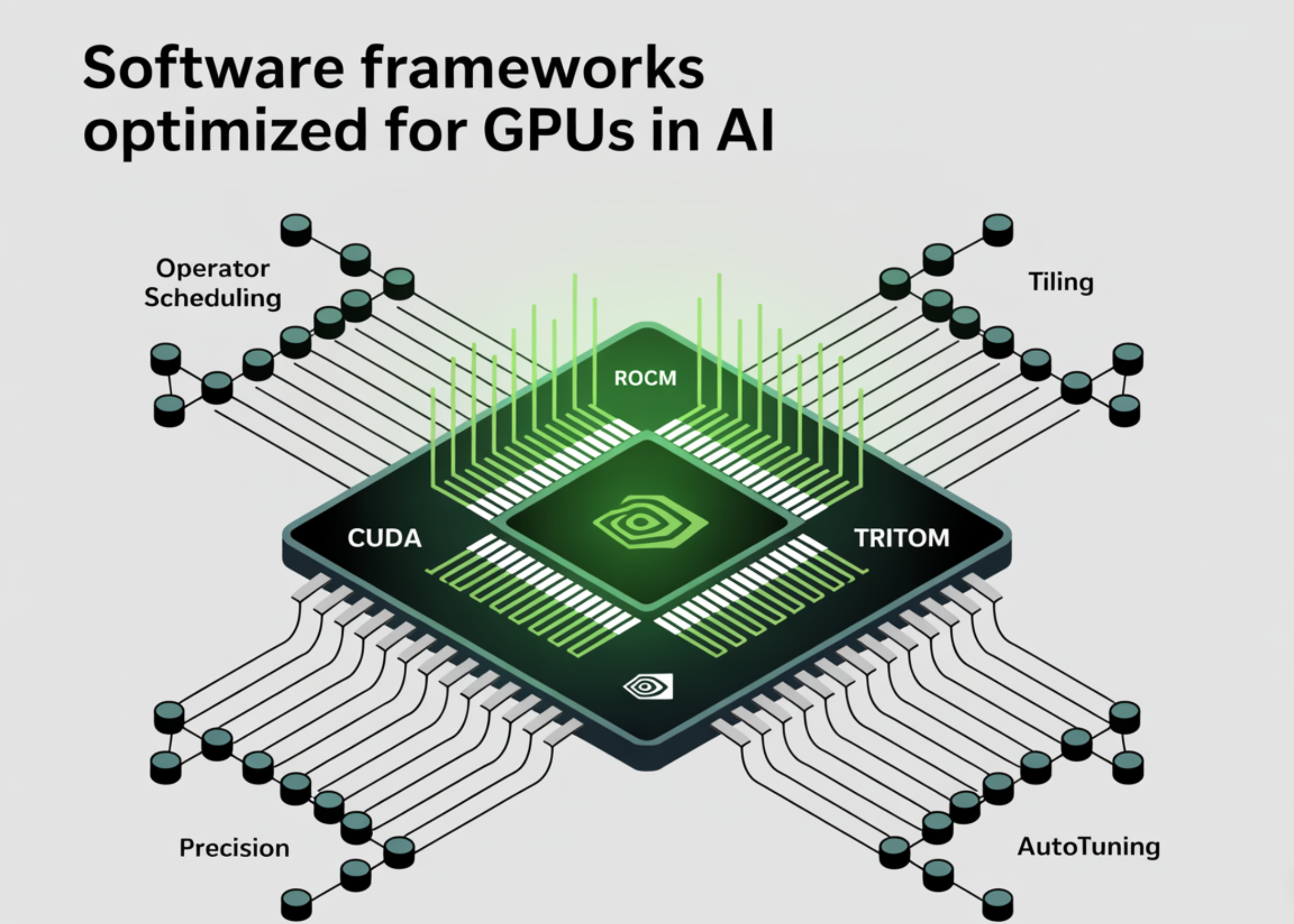
In the realm of artificial intelligence (AI) and machine learning (ML), leveraging graphics processing units (GPUs) has become pivotal. The parallel processing capacity of GPUs accelerates computation-heavy tasks, making them ideal for training complex models. There are several software frameworks designed to optimize GPU performance, among which CUDA, ROCm, Triton, and TensorRT stand out. This post explores these frameworks, their compiler paths, and the implications for performance in AI applications.
What is a GPU and Why is it Important for AI?
Graphics Processing Units (GPUs) are specialized hardware designed for rendering graphics. However, their architecture is also well-suited for executing parallel tasks, making them instrumental for AI workloads. Unlike traditional CPUs, which handle tasks in a linear fashion, GPUs can process thousands of threads simultaneously. This ability is key for AI training and inference tasks, enabling quicker model training and faster predictions.
CUDA: NVIDIA’s Proprietary Framework
Overview of CUDA
CUDA (Compute Unified Device Architecture) is a parallel computing platform developed by NVIDIA. It allows developers to utilize their GPU’s processing power by writing code in various programming languages, including C, C++, and Python. The ability to offload tasks to the GPU can significantly enhance computational speed for AI applications.
Compiler and Performance
CUDA provides a rich set of libraries (such as cuDNN for deep learning) that are highly optimized for NVIDIA GPUs. The CUDA compiler translates high-level code into an efficient form executable by the GPU. Developers benefit from performance profiling tools and libraries that simplify tuning applications for maximum efficiency. By enabling fine-grained control over hardware resources, CUDA allows for significant performance gains, making it a preferred choice for many AI practitioners.
ROCm: AMD’s Open-Source Alternative
Introduction to ROCm
ROCm (Radeon Open Compute) is AMD’s open-source framework designed to harness the power of their GPUs for high-performance computing tasks, including AI and ML. Unlike CUDA, which is tightly coupled with NVIDIA hardware, ROCm aims to provide a more flexible programming environment conducive to cross-platform capabilities.
Compiler and Performance
ROCm employs the LLVM compiler infrastructure, which ensures that developers can write code once and run it across various hardware configurations. The framework leverages libraries such as MIOpen, which offers optimized routines for deep learning workloads. The versatility of ROCm allows developers to harness the computational power of AMD GPUs while maintaining performance efficiency.
Triton: A New Paradigm in AI Programming
What is Triton?
Triton is a relatively new programming language and compiler system designed to optimize high-performance deep learning workloads on GPUs. It enables researchers and developers to write custom GPU kernels with ease, focusing on the logic of their algorithms without getting bogged down by low-level programming specifics.
Performance Implications
Triton is noteworthy for its ability to automatically optimize performance across various GPU architectures. This is achieved through a sophisticated compiler that analyzes the code and generates efficient kernel implementations. By leveraging Triton, users can achieve tailored performance, making it particularly beneficial for research in AI where unique model architectures might be frequently tested.
TensorRT: Streamlining Inference
Introduction to TensorRT
TensorRT is NVIDIA’s high-performance inference engine tailored specifically for deep learning. It optimizes neural network models for deployment, facilitating faster inference times without compromising accuracy. TensorRT complements other frameworks like TensorFlow and PyTorch, allowing seamless integration into existing workflows.
Compiler and Performance
The TensorRT optimizer employs various techniques, such as precision calibration (including FP16 and INT8), layer fusion, and kernel auto-tuning, to boost model inference speeds dramatically. The result is a performance improvement that can often exceed twofold compared to conventional inference solutions. This is crucial for applications where real-time prediction is essential, such as autonomous driving or interactive AI systems.
Comparative Analysis of Compiler Paths
CUDA vs. ROCm
While CUDA provides a tightly integrated suite of tools and libraries for NVIDIA hardware, ROCm’s LLVM-based architecture allows for more flexibility across different hardware. However, developers familiar with NVIDIA’s ecosystem will find CUDA easier to adopt due to its extensive documentation and community support.
Triton vs. Traditional Approaches
Triton challenges traditional GPU programming paradigms by abstracting complexity. While most traditional GPU programming requires in-depth knowledge of CUDA or OpenCL, Triton enables more intuitive coding approaches, democratizing access to GPU acceleration.
Performance Implications Across Frameworks
The choice of software framework can significantly affect the performance of AI applications.
- CUDA: Typically yields high performance for applications specifically tailored for NVIDIA hardware, leveraging its extensive libraries and optimization tools.
- ROCm: Offers competitive performance, especially for users looking to utilize AMD hardware without vendor lock-in.
- Triton: Stands out when custom kernel design is crucial, allowing researchers to push the boundaries of AI complexity and performance.
- TensorRT: Optimizes already trained models for inference, making AI applications more responsive and capable of handling real-time data.
Conclusion
GPU-optimized software frameworks are transforming the landscape of artificial intelligence by enabling faster computations and more efficient model training and inference. Each framework—CUDA, ROCm, Triton, and TensorRT—has its unique strengths and is geared towards different aspects of AI workloads. Understanding these frameworks and their performance implications is crucial for developers aiming to maximize their AI capabilities. As the field continues to evolve, keeping abreast of developments in these frameworks will empower practitioners to harness the full potential of GPU technology for innovative AI solutions.