
Blog
How to Build a Robust Advanced Neural AI Agent with Stable Training, Adaptive Learning, and Intelligent Decision-Making?
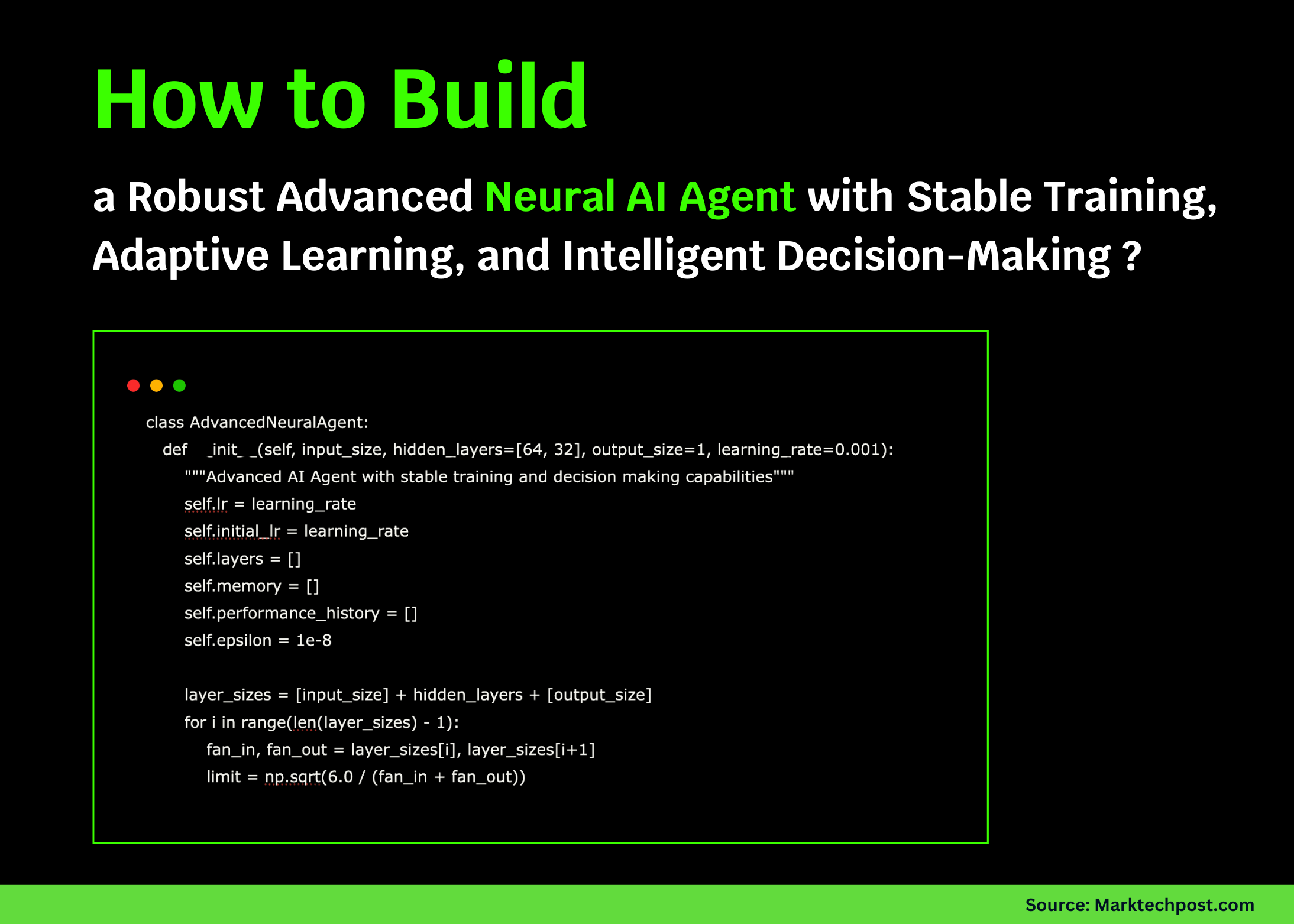
Building a Robust Advanced Neural AI Agent
In recent years, the rise of artificial intelligence (AI) has transformed various industries, ranging from healthcare to finance. One of the key advancements in this area is the development of advanced neural AI agents. These systems can adapt and learn in real time, making intelligent decisions based on complex data. If you’re looking to create a robust neural AI agent, this guide will walk you through essential components such as stable training, adaptive learning mechanisms, and intelligent decision-making capabilities.
Understanding Neural AI Agents
Neural AI agents are systems that use artificial neural networks to simulate human-like decision-making processes. They analyze vast amounts of data, recognize patterns, and adapt their functions to improve their performance over time. The ultimate goal is to create systems that can operate autonomously and make informed decisions without human intervention.
Key Components of an Effective Neural AI Agent
1. Stable Training
The foundation of any effective neural AI agent lies in stable training. Stable training ensures that the learning process is consistent and that the model can be trusted to perform well in various situations.
Importance of Data Quality
The quality of the data used for training plays a significant role. High-quality, diverse datasets enable the model to learn more effectively, allowing it to generalize better in unseen scenarios. Ensure that the data is comprehensive and covers various aspects of the problem you’re addressing.
Regularization Techniques
Incorporating regularization techniques is crucial to avoid overfitting. Methods such as L1 and L2 regularization can be employed to minimize the model’s complexity while improving its ability to generalize from the training data.
Hyperparameter Optimization
Fine-tuning hyperparameters, such as learning rate and batch size, is essential for achieving stable training. Utilize techniques like grid search or random search to find the optimal settings for your specific use case.
2. Adaptive Learning Mechanisms
Adaptive learning mechanisms allow the AI agent to evolve and adjust its strategies based on new inputs and experiences. This ensures that the agent remains relevant and effective over time.
Reinforcement Learning
Reinforcement learning (RL) is a popular approach that enables AI agents to learn through trial and error. In this framework, the agent receives rewards or penalties based on its actions, encouraging it to adopt strategies that maximize long-term rewards.
Transfer Learning
Transfer learning allows your AI agent to leverage knowledge gained from one task to improve performance on another related task. This not only speeds up the training process but also enhances the model’s adaptability.
Continuous Learning
Implementing continuous learning ensures that your AI agent remains updated with new data and insights. This can involve periodically retraining the model on new datasets or using online learning approaches, where the model evolves with incoming data in real time.
3. Intelligent Decision-Making
The ultimate goal of an advanced neural AI agent is to make intelligent decisions. To achieve this, the agent must effectively analyze data and derive actionable insights.
Contextual Awareness
For an AI agent to make informed decisions, it needs a deep understanding of the context in which it operates. Incorporating contextual data can greatly enhance its decision-making capabilities.
Decision Trees and Probabilistic Models
Using decision trees or probabilistic models can help the AI agent evaluate various possible outcomes and choose the most promising course of action. These models can offer transparency in the decision-making process, enhancing trustworthiness.
User Intent Recognition
Incorporating natural language processing (NLP) techniques can help the AI agent recognize user intent effectively. This allows for better interactions and can significantly improve the decision-making process.
Building the Framework
Choosing the Right Tools and Libraries
Selecting an appropriate set of tools and libraries is essential for developing your neural AI agent. Popular frameworks like TensorFlow, PyTorch, and Keras provide extensive functionalities and resources to facilitate the building process.
Scalability Considerations
Ensure that the frameworks you choose can scale with your projects. As your datasets grow and calculations become more complex, having scalable tools will save time and resources.
Setting Up the Infrastructure
A robust infrastructure is essential for AI deployment. This includes selecting suitable hardware, such as GPUs for faster computations, and establishing cloud solutions for data storage and processing.
Cloud Versus On-Premises
Evaluate the pros and cons of cloud-based versus on-premises solutions based on your specific requirements, such as budget, data sensitivity, and scalability.
Testing and Evaluation
Once you’ve built your AI agent, thorough testing is critical to assess its performance and reliability.
Metrics for Evaluation
Adopt various evaluation metrics depending on the task at hand. Common metrics, such as accuracy, precision, and recall, can provide insights into the model’s effectiveness.
User-Focused Testing
Incorporate user feedback during the testing phase to identify any gaps in performance and areas for improvement. Real-world testing can provide valuable insights that technical assessments might overlook.
Deployment and Maintenance
After testing, the next step is deployment. An effective deployment strategy minimizes disruptions and maximizes performance.
Monitoring Performance
Post-deployment, continuous monitoring is essential. Track the AI agent’s performance over time to ensure it remains effective and adapts as needed.
Feedback Loops
Implement feedback loops that allow the AI agent to learn from user interactions. This adds another layer of adaptability, ensuring that the agent evolves with changing requirements.
Conclusion
Building a robust advanced neural AI agent is a multifaceted process that demands attention to various components, ranging from stable training to intelligent decision-making. By focusing on high-quality data, adaptive mechanisms, and continuous evaluation, you can create an AI agent that not only responds to current needs but also adapts and thrives in an ever-evolving landscape. As technology continues to evolve, investing in AI development will undoubtedly pave the way for innovative solutions and transformative outcomes across industries.
